


Knowledge bank
Diaphragm pump, centrifugal pump or magnetically driven pump – how to choose the right one
Broadly speaking, it can be said that a diaphragm pump is often a flexible choice for demanding and variable media; a centrifugal pump is suitable when a steady flow and continuous operation are important; whilst a magnetically driven pump is a good option when seal-less operation and a minimised risk of leakage are high on the list of requirements.
However, the right choice of pump depends on the fluid, the required flow rate and back pressure, as well as how sensitive the process is to particles, dry running and leakage.
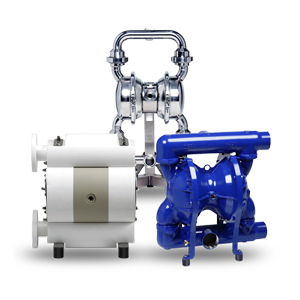
diaphragm pump
Centrifugal pump


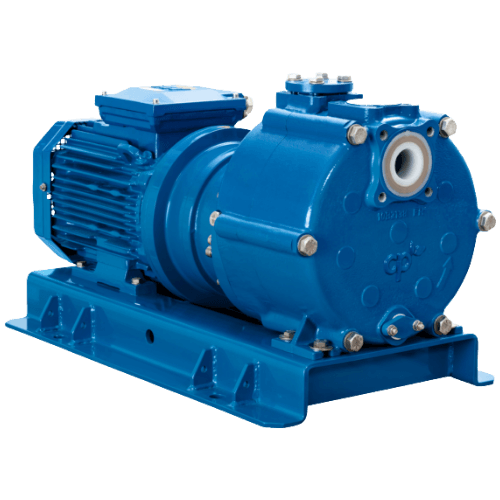
Magnetically driven pump
When should you choose a diaphragm pump rather than a centrifugal pump?
You should primarily choose a diaphragm pump when the fluid is difficult to pump – for example, if it is viscous, contains particles or is contaminated – or when the pump needs to be capable of self-priming and withstanding dry running.
If, on the other hand, large, steady flow rates and continuous operation are the most important factors, a centrifugal pump is often a better choice.
When a diaphragm pump is the right choice
As mentioned, the diaphragm pump is suitable for use where the fluid or operating conditions are demanding. The pump is self-priming and is suitable for, amongst other things, viscous, particulate-laden and contaminated fluids, as well as in situations where dry running or variable operating conditions may occur.
Choose a diaphragm pump when:
- The medium contains particles or is viscous
- Self-priming or running dry is important
- Operation is intermittent or variable
- It must be possible to regulate the flow
The diaphragm pump produces a pulsating flow, which can be a disadvantage when the process requires a very steady flow.
When a centrifugal pump is the right choice
The centrifugal pump is best suited to continuous operation, high flow rates and situations where a steady flow is important. It is particularly suitable for relatively free-flowing fluids and can offer good operational economy.
Choose a centrifugal pump when:
- The flow is heavy and continuous
- A steady flow is important
- The medium is relatively fluid
- Low operating costs are a priority
When neither of them is suitable
In some applications, neither a diaphragm pump nor a centrifugal pump is the right choice.
A peristaltic pump, for example, is well suited to slurry, sludge and abrasive media, whilst a piston metering pump may be an alternative for high-pressure applications and precise metering. For viscous media, a gear pump may also be suitable.
You should therefore not base your choice on the question ”Which pump do I want?”, but rather on the question ”What requirements must the pump meet?”
A magnetically driven solution or another solution without a seal?
Where there is a risk of leakage, a magnetically driven, seal-less centrifugal pump is often a good option. As it has no mechanical shaft seal, this reduces the risk of leakage into the surrounding environment and also minimises the need for maintenance associated with the shaft seal.
A magnetically driven pump is particularly suitable for pumping chemicals or other fluids where a leak could have serious consequences.
See our magnetically driven pumps
What this difference means in practice
In a traditional shaft-sealed centrifugal pump, the shaft seal is a point where the fluid may leak out and where maintenance may be required.
In a magnetically driven pump, the drive is transmitted through the pump casing without any mechanical connection. The result is a seal-less design with a minimised risk of leakage.
Above all, it affects three things:
- Safety: the risk of leakage into the surrounding environment is reduced
- Maintenance: no mechanical shaft seal requires maintenance
- Operation: The pump must be operated within the operating conditions specified for the relevant design
However, magnetically driven centrifugal pumps are not a universal solution. Many models are designed for clean, non-viscous liquids, and particles and fibres can cause problems in the pump’s internal components.
Dry running is also a significant risk factor for many magnetically coupled pumps.
When magnetic drive is appropriate
Magnetic drive is particularly justified when seal-less operation is a requirement or offers a clear advantage, and the fluid is also compatible with the pump’s hydraulics and materials.
This may, for example, be relevant when:
- The medium is aggressive or harmful to health
- Leaks must be minimised
- Continuous operation is important
- The medium is clear and relatively free-flowing
- Maintenance of mechanical shaft seals should be avoided
That does not mean that a magnetically driven pump is always better than a shaft-sealed centrifugal pump.
If the fluid is clean and the risk of leakage can be managed in other ways, a sealed solution may be entirely sufficient. However, if the fluid contains a high level of particles or fibres, or has other properties that are unsuitable for a magnetic drive pump, a different pumping principle should be considered.
A peristaltic pump or a dosing pump for chemical dosing?
When it comes to dosing a precise quantity of a chemical, a dosing pump is normally the right choice. A peristaltic pump, on the other hand, is particularly suitable when the medium is abrasive, contains particles or is difficult to handle, and dosing accuracy is not the most important requirement.
Requirements for dosing accuracy
When it comes to chemical dosing, the question is not just how much liquid is to be pumped, but how precisely the quantity must be controlled and repeated.
Metering pumps are designed to dispense controlled volumes over time and are used when accuracy and repeatability are essential. Diaphragm, piston and piston-diaphragm pumps are used for various types of metering tasks.
Where high dosing accuracy is important, a dosing pump should therefore be chosen over a standard transfer pump.
If, on the other hand, the requirement is for a flow that is as steady and pulsation-free as possible, a gear pump may be an option.
Abrasive and particulate media
When dealing with slurry, sludge and other media containing particles or which are abrasive, a peristaltic pump is often a robust option.
The fluid is contained within the hose and does not come into contact with the pump’s other components. This makes the hose pump suitable for applications such as lime slurry, sludge and other abrasive liquids.
A peristaltic pump can also be a good option when high suction capacity is important.
However, a diaphragm or piston-diaphragm pump is often a better choice if the process places very high demands on dosing accuracy.
Selection criteria: compare pump types
There is no single type of pump that is best for all applications. The final choice must be based on the actual medium and the operating conditions of the process.
When comparing diaphragm pumps, centrifugal pumps and magnetically driven pumps, the following criteria need to be assessed:
- Aggressive media
- Particles
- High viscosity
- Large flows
- Steady flow
- Counterpressure
- Risk of running dry
- High dosing accuracy
- Pulsation
- Seal-free operation
Pump selection for corrosive media
Common mistakes and what they cost
Choosing the wrong pump does not necessarily lead to an immediate breakdown. Often, the problem first becomes apparent through higher maintenance costs, erratic operation, unnecessary wear and tear, or the process not functioning as planned.
| Wrong choice | Consequence | What should have been chosen |
|---|---|---|
| Centrifugal pump for a highly viscous fluid | Reduced performance and an unsuitable operating point | Diaphragm pump, peristaltic pump or other positive displacement pump |
| Magnetically driven pump for a medium containing a large number of particles | Risk of problems with the pump’s internal components | Diaphragm pump or peristaltic pump, depending on the application |
| A standard transfer pump when precise chemical dosing is required | Difficult to control and repeat the dosage | Metering pump |
| Diaphragm pump when the process requires a steady, high flow rate | Pulsation and reduced heating for continuous transport | Centrifugal pump |
| Centrifugal pump in which dry running may occur | Risk of injury depending on the pump design | Diaphragm pump or other suitable self-priming pump |
How we draw up a recommendation
In order for us at Lyma to be able to draw up a recommendation, we need to understand both the medium and the process.
We draw up a recommendation based on:
- Medium: What is to be pumped, and what are the properties of the fluid?
- Particles: Are there any particles, fibres, sludge or abrasive materials present?
- Viscosity: How free-flowing or viscous is the medium?
- Flow: What flow rate is required, and should it be constant or variable?
- Counterprint: What back pressure must the pump operate against?
- Operation: Is the process continuous, intermittent or variable?
- Sealing requirements: How serious are the consequences of a potential leak?
At Lyma, we work with centrifugal pumps, diaphragm pumps, peristaltic pumps and dosing pumps, amongst other things, and we are therefore able to compare several pump principles against the same process requirements.
Do you need help choosing the right pump?
We have extensive experience in helping to assess pump type, materials and sizing.
Does your business need a pump for chlorine, chemicals or another solution for corrosive media? Contact us for help in finding the right pump!