


Knowledge bank
Materials guide: which plastics are resistant to which chemicals
Which plastics can actually withstand which chemicals? In this guide, we look at how to select materials for corrosive flows, and which plastic is best suited to a particular corrosive flow. The short answer is that it is usually determined by a combination of the medium, concentration, temperature and operating pressure.
At Lyma, we work primarily with three families of materials: thermosetting plastics and glass-fibre-reinforced plastics, thermoplastics and fluoroplastics. The correct material is selected on the basis of the actual operating conditions.
How to choose materials for corrosive flows
The choice of materials can be broken down into four steps:
- Determine the medium and concentration
- Set the temperature
- Determine the operating pressure and operating conditions
- Select material
A resistance table is an important reference, but it does not in itself constitute a final choice of material. The values in the table need to be considered in relation to how the facility will actually be used.
What determines the choice
The first step, therefore, is to identify the substance to be transported and its concentration. The temperature then needs to be determined. The same chemical can present completely different conditions at different temperatures.
Operating pressure is also a factor. A material may have good chemical resistance but still be unsuitable for a particular application due to pressure, dimensions or mechanical stress.
In addition, operating time and how the flow is utilised need to be taken into account. Continuous exposure, short-term temperature peaks, fluctuating operating conditions and the presence of particles can influence the choice of material.
Ultimately, it is the combination of these factors that determines which material is most suitable.
How to read a resistance problem
A resistance specification normally indicates how a material reacts to a particular medium at a specific concentration and temperature. Depending on the manufacturer, the material’s suitability may be indicated using different designations or ratings.
It is important to understand what the task actually entails. A value for a pure medium at a given temperature does not automatically indicate how the material will perform in a mixture, in the presence of particles, or under varying operating conditions.
A resistance table should therefore be regarded as a starting point for the choice of materials and not as a decision in its own right.
The different types of plastic and what sets them apart
The plastics used in applications subject to corrosion can be broadly divided into three families. The difference lies primarily in their combination of chemical resistance, temperature resistance, mechanical properties and cost.
| Material family | Examples | Typical uses | Main limitation |
|---|---|---|---|
| Thermoset/GAP/GRE | Glass-fibre-reinforced polyester, vinyl ester, epoxy | Valves, pipes, tanks | The choice of materials is strongly influenced by the medium and the design |
| Thermoplastic | PE, PP, PVC | Pumps, valves, pipes, tanks | Temperature and mechanical stress limit its use |
| Fluorinated plastic | PTFE, PFA, PVDF, FEP, ETFE | Pumps, valves, pipes, tanks | Varying mechanical properties |
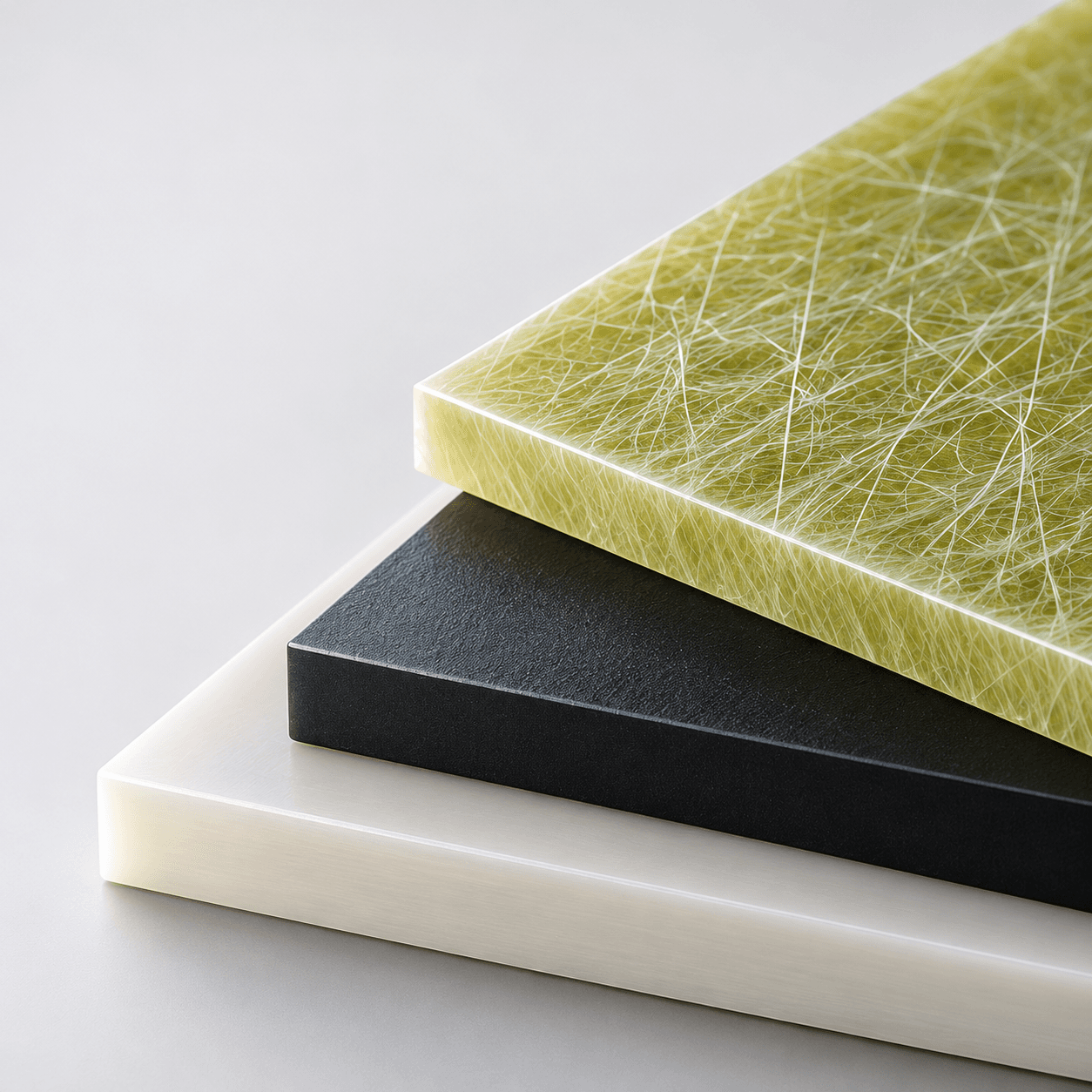
Thermosetting plastics and glass-fibre-reinforced plastics
GAP stands for glass fibre-reinforced plastic and GRE for Glass Reinforced Epoxy. Both are composite materials in which glass fibre is used as reinforcement, but with different types of plastic matrix. GAP is a collective term for glass-fibre-reinforced plastic, whilst GRE specifically refers to composites with an epoxy-based plastic matrix. The materials are used, amongst other things, in pipework, tanks and large-scale structures where low weight, corrosion resistance and dimensional stability are important properties.
Compared with many thermoplastics, GAP may be a suitable choice for larger installations and structures where the material’s rigidity and structure are key factors. At the same time, it is important to select the correct resin system for the specific medium and operating conditions.
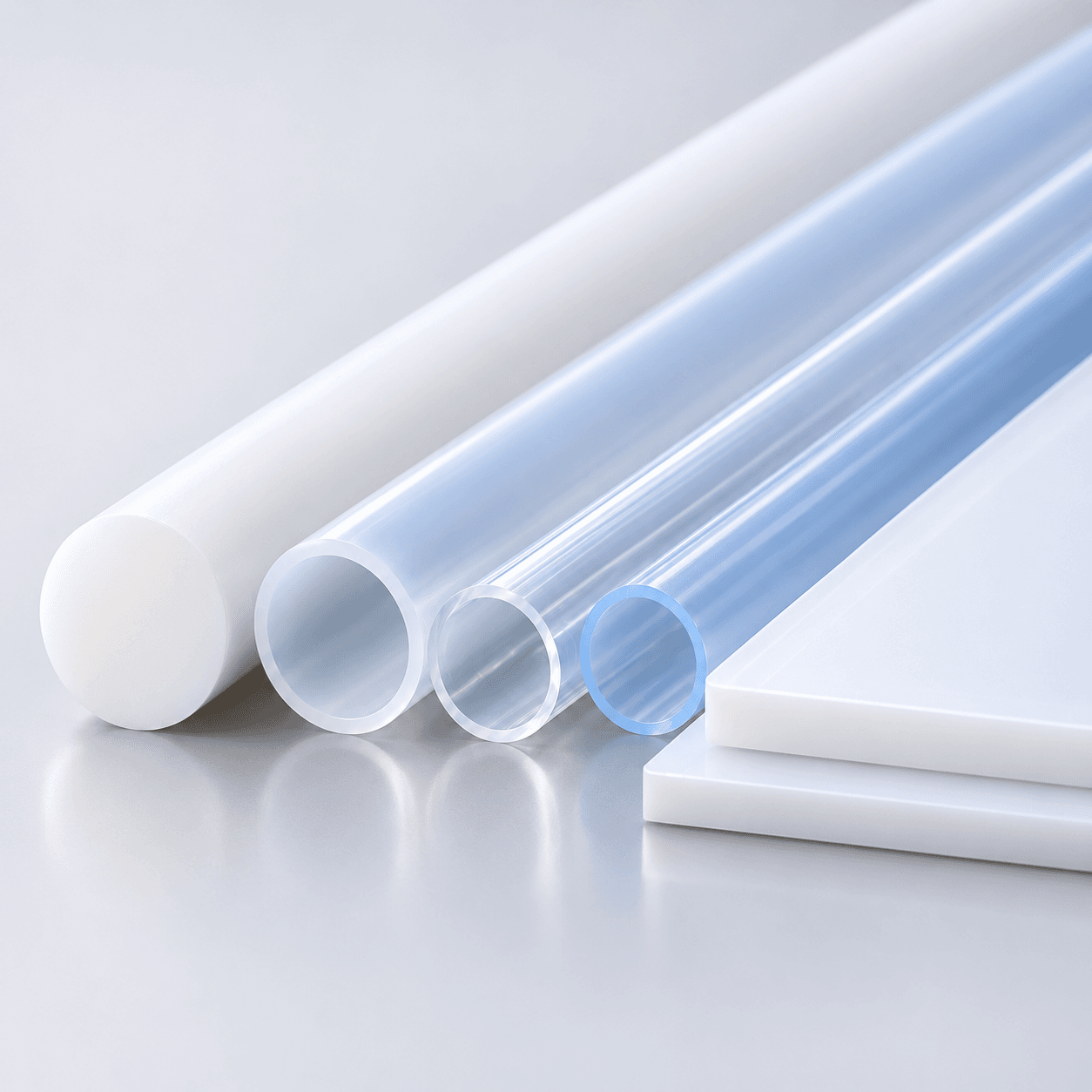
Thermoplastics: PE, PP and PVC
PE, PP and PVC are common thermoplastics used in pipework and other components that are exposed to chemicals. They differ in terms of, amongst other things, temperature resistance, mechanical properties and chemical resistance.
PE is used in many environments prone to corrosion where good chemical resistance and impact strength are required. PP is often used where a higher temperature resistance than that of PE is required. PVC is commonly used in chemical pipework systems where the material’s combination of chemical resistance, rigidity and cost is suitable for the application.
When the temperature, concentration or chemical load becomes too high, a fluoroplastic material may be a better option. The exact limit must always be assessed in relation to the specific medium and operating conditions.
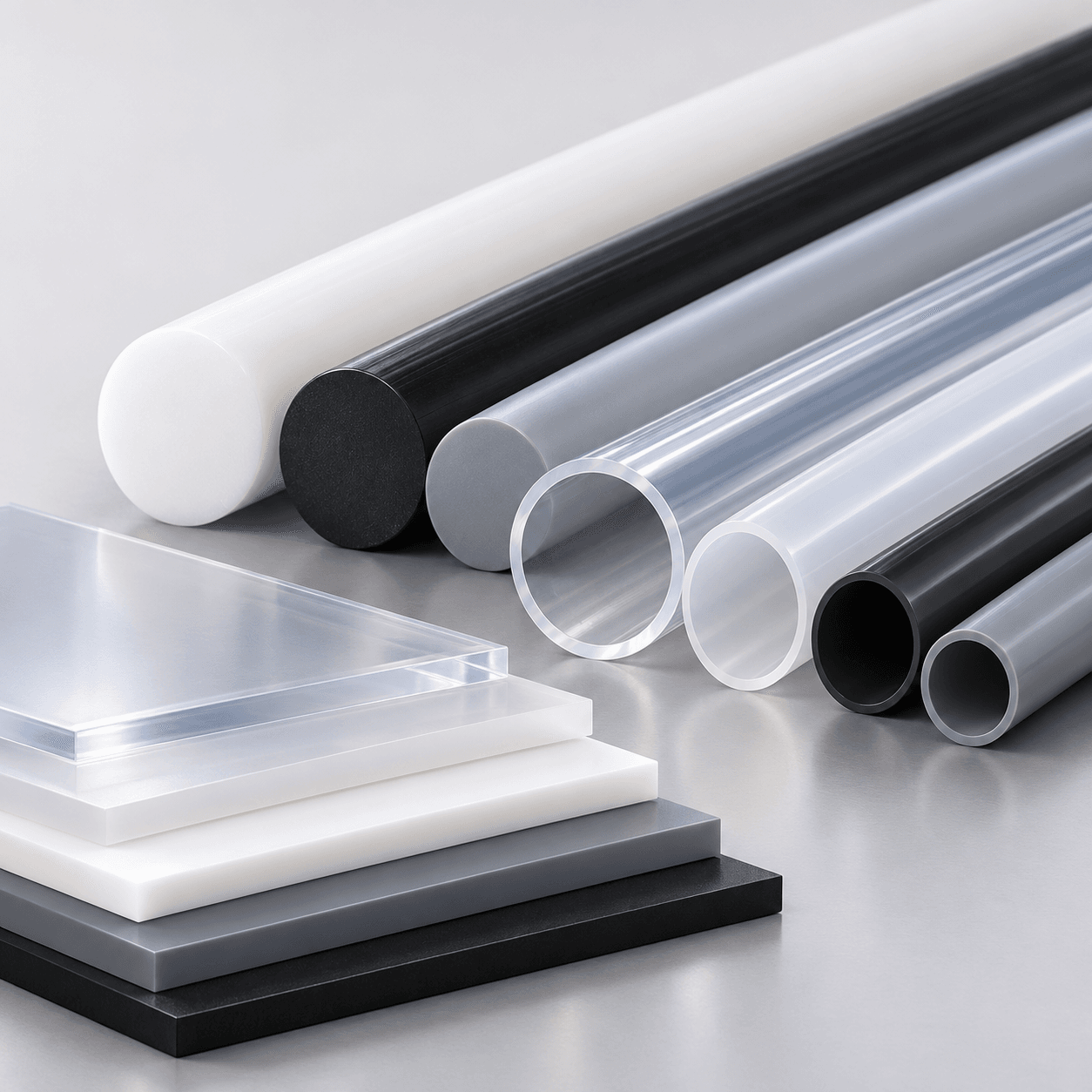
Fluoroplastics: PTFE, PFA, PVDF, FEP and ETFE
Fluoropolymers are used when the requirements for chemical resistance or temperature resistance exceed what conventional thermoplastics can withstand. PTFE offers very broad chemical resistance, whilst PFA and FEP combine chemical resistance with good temperature resistance. PVDF offers good chemical resistance and mechanical rigidity, whilst ETFE is suitable when both chemical resistance and mechanical strength are important.
Exact limits depend on the medium and operating conditions and must always be verified for the specific application.
Which materials can withstand hydrochloric acid?
PVC, PP, PVDF and PTFE can be used with hydrochloric acid, but the correct material depends on the concentration and temperature. For milder operating conditions, PVC and PP may be suitable, whilst PVDF or PTFE are better options when the temperature or chemical load increases:
| Hydrochloric acid | temperature | Suitable materials |
|---|---|---|
| 20 % | 40 degrees | PVC, PP, PVDF, PTFE |
| 25 % | 40 degrees | PVC, PP, PVDF, PTFE |
| 35 % | 40 degrees | PVC, PP, PVDF, PTFE |
| 35–38 % | 80 degrees | PVDF, PTFE |
Recommendations by concentration and temperature
At lower temperatures, PVC and PP can be cost-effective alternatives for hydrochloric acid. As concentration or temperature increases, PVDF or PTFE become suitable options, as they offer excellent resistance even under more demanding conditions.
When the material needs replacing
There is no universal limit at which, for example, PP suddenly ceases to function. The suitability of the material changes gradually depending on concentration, temperature and exposure time. Therefore, the choice of material should be revised if the process conditions change or if the temperature and concentration approach the material’s documented limit values.
When plastic isn’t enough
Solid plastic is a good option in many corrosive environments, but in cases involving high pressures, large dimensions or high temperatures, other solutions may sometimes be more suitable. By combining the corrosion resistance of plastic with, for example, a load-bearing material or an internal plastic lining, it is possible to create structures that meet high standards for both strength and chemical resistance.
Metal lined with fluoroplastic
Fluoroplastic-lined metal combines the mechanical strength of metal with the chemical resistance of fluoroplastic. It can be an alternative when solid plastic does not provide sufficient mechanical stability or when the design places high demands on pressure or temperature.
Epoxy and glass-fibre-reinforced pipework systems
Epoxy- and glass-fibre-reinforced pipework systems are used, for example, in large-scale industrial installations where corrosion resistance, low weight and large dimensions are important. Compared with metal pipes, composite materials are significantly lighter, which can be a major advantage for large-diameter pipes, as it can reduce the load on load-bearing structures and simplify handling and installation. These materials can therefore be a suitable alternative when both corrosion resistance and weight need to be taken into account in the design.
Graphite
Graphite is used in particularly demanding chemical and thermal environments, including in components where high chemical resistance and thermal conductivity are key properties. It can be an alternative when plastic materials do not meet the requirements for the application in question.
How we draw up the recommendation
A material recommendation must be based on more than just a single entry in a resistance table. Lyma combines experience from industrial applications with technical data from materials and component manufacturers.
Safety margin and why table values are not sufficient
Resistance tables are based on specified conditions. The actual installation, however, may involve different conditions, such as variations in temperature, concentration, pressure or exposure time.
A safety margin must therefore be taken into account when selecting materials. The size of the margin required depends on the application and the risk profile, and should not be specified as a general percentage applicable to all materials and media.
Lyma’s recommendation is therefore based on the actual combination of medium, concentration, temperature, pressure and operating conditions.
Information we need from you
In order for us to assess which material is suitable, we need to know:
- Which media is to be transported
- Media concentration
- temperature
- Operating pressure
- Whether the flow is continuous or intermittent
- Expected operating time and exposure
- Pipe size, component or current design
The more comprehensive the data is, the more reliable the material assessment will be.
Do you have a specific chemical or process for which you’d like to find the right material? Contact Lyma with your operational data and we can help you assess the most suitable material!